
Key Takeaways
- Skin treatments often aren’t enough. Between 83% and 88% of people in every group said creams and other topical treatments didn’t work well enough for their HS.
- Many people with HS get no whole-body treatment. No one with HS alone was taking a systemic (whole-body) medication. Among people with other conditions like IBD or thyroid disease, fewer than 1 in 10 were.
- DMARD use was linked with fewer HS symptoms. People taking disease-modifying antirheumatic drugs (DMARDs) reported fewer painful abscesses and better results on six HS symptoms. More research is needed to understand why.
A 2026 survey of 462 people reporting symptoms of hidradenitis suppurativa (HS) by the Global Healthy Living Foundation (GHLF) found that people taking DMARDs — medications often prescribed for inflammatory conditions, such as rheumatoid arthritis (RA), psoriatic arthritis (PsA), or ankylosing spondylitis (AS)— reported fewer painful HS symptoms than those who weren’t. The findings will be shared at ACR Convergence 2026, the American College of Rheumatology’s annual meeting, held November 6–11 in Orlando, Florida.
GHLF and its patient research registry, PatientSpot, are presenting six research studies at this year’s meeting. This study looks at HS where it overlaps with rheumatology, with important takeaways for people managing HS alongside arthritis or other rheumatic conditions.
What is hidradenitis suppurativa?
Hidradenitis suppurativa (HS) is a long-term inflammatory skin condition. It causes painful lumps, abscesses, and wounds that can drain, usually in areas where skin rubs together, such as the armpits, groin, buttocks, and under the breasts. Over time, HS can cause tunnels under the skin and scarring.
HS is more common in people who have other immune-related conditions, including rheumatic diseases such as rheumatoid arthritis (RA), psoriatic arthritis (PsA), and ankylosing spondylitis (AS).
What are DMARDs, biologics, and JAK inhibitors?
These are systemic medications, which means they work throughout the whole body rather than just on the skin. They calm the overactive immune system that drives inflammation.
- DMARDs (disease-modifying antirheumatic drugs) are medications such as methotrexate that slow down inflammatory diseases like RA, lupus, AS, or PsA..
- Biologics are medications made from living cells that target specific parts of the immune system. Some biologics are FDA-approved to treat HS.
- JAK inhibitors are pills that block certain signals inside immune cells that cause inflammation.
People with rheumatic diseases often take these medications for their inflammatory condition, sucha as RA or lupus. This gave researchers a chance to see whether they might also be linked with HS symptoms.
How was the study done?
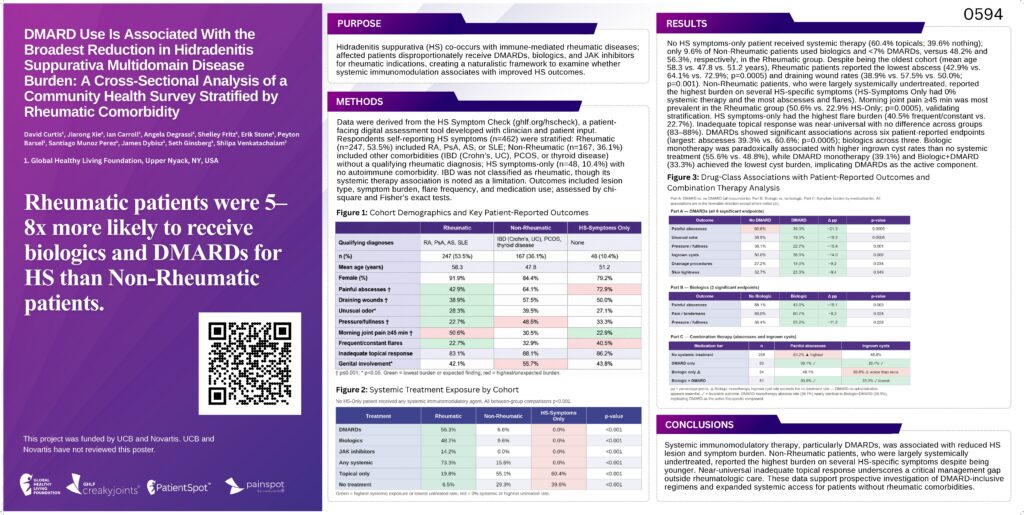
The data came from the HS Symptom Check, a free online tool GHLF created with input from doctors and patients. A total of 462 people who reported HS symptoms were included. Researchers sorted them into three groups:
- Rheumatic group (247 people): HS plus RA, PsA, AS, or lupus
- Non-rheumatic group (167 people): HS plus another condition, such as inflammatory bowel disease (IBD), polycystic ovary syndrome (PCOS), or thyroid disease
- HS-only group (48 people): HS with no other immune-related condition
Researchers compared the groups on HS symptoms, flares, and the medications people were taking.
What did the study find?
Many people with HS aren’t getting whole-body treatment.
There were big differences in who was taking systemic medications:
- Rheumatic group: 56% took DMARDs, 48% took biologics, and 14% took JAK inhibitors
- Non-rheumatic group: 7% took DMARDs and 10% took biologics
- HS-only group: No one took a systemic medication. About 60% used only topical treatments, and 40% used no treatment at all.
People in the rheumatic group were 5 to 8 times more likely to be taking biologics and DMARDs than people in the non-rheumatic group. Topical treatments often fall short.
In all three groups, 83% to 88% of people said topical treatments, such as creams, didn’t work well enough for their HS. People in the rheumatic group reported fewer abscesses and wounds.
Even though people in the rheumatic group were the oldest on average, they reported the fewest HS skin symptoms:
- Painful abscesses: 43% in the rheumatic group, compared with 64% in the non-rheumatic group and 73% in the HS-only group
- Draining wounds: 39% in the rheumatic group, compared with 58% in the non-rheumatic group and 50% in the HS-only group
People in the non-rheumatic group, who rarely took systemic medications, reported the most pressure or fullness in their skin (49% vs. 23% in the rheumatic group). People with HS only had the most frequent flares: 41% said their flares were frequent or constant, compared with 23% in the rheumatic group. DMARDs were linked with the widest range of benefits.
People taking DMARDs reported better results on six HS symptoms compared with those not taking them. The biggest difference was in painful abscesses: 39% of people taking DMARDs reported them, compared with 61% of those who weren’t. Biologics were linked with better results on three symptoms.
Researchers also looked at combinations of medications. People taking a DMARD, alone or with a biologic, reported the fewest ingrown cysts. Surprisingly, people taking only a biologic (without a DMARD) reported ingrown cysts a little more often than people taking no systemic treatment at all (56% vs. 49%). The researchers say this suggests DMARDs may be an important part of the picture, but this needs more study.
What does this study tell us — and what can’t it?
This study shows a link between DMARD use and fewer HS symptoms. It does not prove that DMARDs caused the improvement. People in the survey reported their own symptoms and medications, and many were taking these medications for arthritis or lupus, not for HS. Larger studies that follow people over time are needed.
The findings also point to a gap in care. People with HS who don’t have a rheumatic disease often aren’t offered systemic treatment, even when topical treatments aren’t working.
Always talk with your doctor before starting, stopping, or changing any medication.
How can you use these findings in your own care?
- Tell all your doctors about your HS. If you see a rheumatologist, let them know about your skin symptoms. If you see a dermatologist, tell them about any joint pain or other conditions.
- Speak up if topical treatments aren’t working. You’re not alone. Ask your doctor whether a systemic treatment might be an option for you.
- Ask how your medications affect each condition. If you take a DMARD or biologic for arthritis, ask whether it may also play a role in managing your HS.
- Check your symptoms. The free HS Symptom Check can help you keep track of your symptoms and prepare for appointments.
Where can I see this research, and how can I get involved?
The poster, “DMARD Use Is Associated with the Broadest Reduction in Hidradenitis Suppurativa Multidomain Disease Burden: A Cross-Sectional Analysis of a Community Health Survey Stratified by Rheumatic Comorbidity,” will be presented by Shilpa Venkatachalam of GHLF during Poster Session A — Patient Outcomes, Preferences, & Attitudes on Sunday, November 8, 2026, from 10:30 AM to 12:30 PM ET (poster 0594).
The research team includes David Curtis, Jiarong Xie, Ian Carroll, Angela Degrassi, Shelley Fritz, Erik Stone, Peyton Barsel, Santiago Munoz Perez, James Dybisz, Seth Ginsberg, and Shilpa Venkatachalam of GHLF. This project was funded by UCB and Novartis, which did not review the poster.
Studies like this one happen because patients share their experiences. To take part in future research, join PatientSpot, GHLF’s patient research registry.
Frequently asked questions
What is hidradenitis suppurativa?
Hidradenitis suppurativa (HS) is a long-term inflammatory skin condition that causes painful lumps, abscesses, and draining wounds, usually in areas where skin rubs together, such as the armpits and groin. Do topical treatments work for HS?
In a 2026 GHLF survey of 462 people reporting HS symptoms, 83% to 88% said topical treatments did not work well enough for their symptoms. Are DMARDs linked with fewer HS symptoms?
In the same survey, people taking DMARDs reported fewer painful abscesses (39% vs. 61%) and better results on six HS symptoms. The study shows a link, not cause and effect, and more research is needed. Is HS connected to inflammatory rheumatic conditions?
HS is more common in people with other immune-related conditions, including rheumatoid arthritis, psoriatic arthritis, ankylosing spondylitis, and lupus.
Wondering if you have HS?
If you have painful lumps, abscesses, or draining wounds that keep coming back, you’re not alone. The free HS Symptom Check can help you learn whether your symptoms may point to HS, and what to ask your doctor next.
Curtis D, Xie J, Carroll I, et al. DMARD use is associated with the broadest reduction in hidradenitis suppurativa multidomain disease burden: a cross-sectional analysis of a community health survey stratified by rheumatic comorbidity [abstract]. Arthritis Rheumatol. 2026;78(suppl 9). Accessed November 3, 2026. https://acrabstracts.org/abstract/dmard-use-is-associated-with-the-broadest-reduction-in-hidradenitis-suppurativa-multidomain-disease-burden-a-cross-sectional-analysis-of-a-community-health-survey-stratified-by-rheumatic-comorbidity/