
Key Takeaways
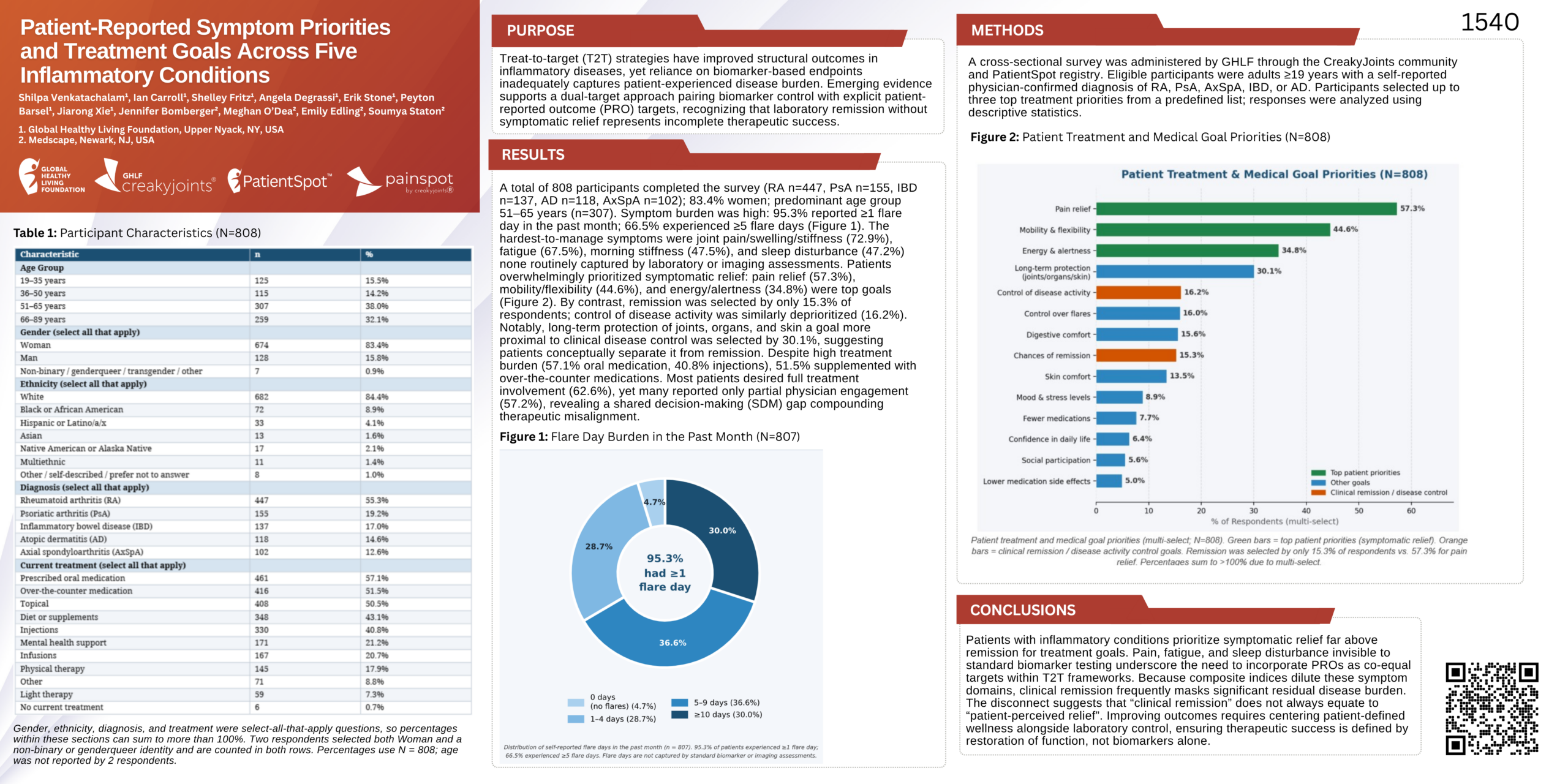
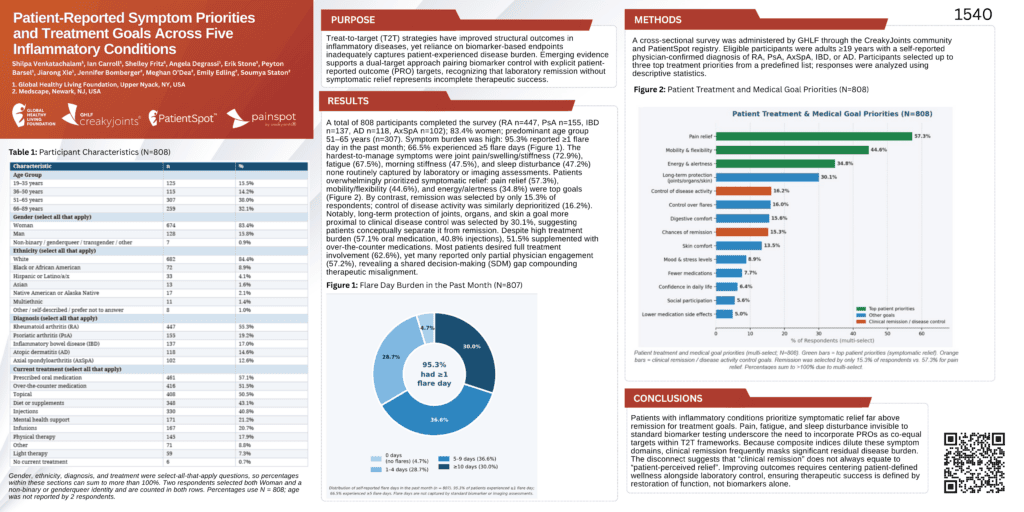
- Nearly everyone is still having flares. About 95% of people surveyed had at least one flare day in the past month, and about 2 in 3 had five or more.
- Patients want to feel better. Pain relief (57%), easier movement (45%), and more energy (35%) were the top treatment goals. Only about 15% chose remission.
- Many patients want a bigger say in their care. Most people wanted to be fully involved in treatment decisions, but many said their doctor only partly involved them.
A 2026 survey of 808 people with five inflammatory conditions by the Global Healthy Living Foundation (GHLF) found that pain relief, mobility, and energy matter far more to patients than reaching remission. The findings will be shared at ACR Convergence 2026, the American College of Rheumatology’s annual meeting, held November 6–11 in Orlando, Florida.
GHLF and its patient research registry, PatientSpot, are presenting six research studies at this year’s meeting. This study looks across several conditions to show how patients rank their symptoms and set treatment goals. The results challenge the idea that one approach to care works for everyone.
Which conditions did the survey include?
The survey included adults with a doctor-confirmed diagnosis of one or more of these inflammatory conditions:
- Rheumatoid arthritis (RA): an autoimmune disease that causes joint pain, swelling, and stiffness
- Psoriatic arthritis (PsA): a type of arthritis that often occurs with the skin condition psoriasis
- Axial spondyloarthritis (axSpA): a type of arthritis that mainly affects the spine and back
- Inflammatory bowel disease (IBD): conditions such as Crohn’s disease and ulcerative colitis that cause inflammation in the digestive tract
- Atopic dermatitis (AD): a common type of eczema that causes itchy, inflamed skin
Why does this research matter?
Many doctors use an approach called treat-to-target. This means setting a clear goal, often remission or low disease activity, and adjusting treatment until that goal is reached. Doctors usually measure progress with lab tests, imaging, and exams.
This approach has helped protect joints and organs from damage. But lab tests can’t measure everything. Someone may look like they’re in remission on paper and still live with pain, fatigue, or poor sleep every day.
That’s why researchers are calling for patient-reported outcomes — what patients say about how they feel and function — to count just as much as lab results.
Who took part in the survey?
GHLF invited people through the CreakyJoints community and the PatientSpot registry. A total of 808 adults took part:
- Rheumatoid arthritis: 447 people
- Psoriatic arthritis: 155 people
- Inflammatory bowel disease: 137 people
- Atopic dermatitis: 118 people
- Axial spondyloarthritis: 102 people
Some people had more than one condition. Most participants (83%) were women, and the largest age group was 51 to 65.
Participants were asked to choose up to three top treatment goals from a list.
What did people say about their symptoms?
Flares are common. About 95% of participants had at least one flare day in the past month. About 2 in 3 had five or more flare days, and 30% had 10 or more.
The hardest symptoms to manage were:
- Joint pain, swelling, or stiffness (73%)
- Fatigue (68%)
- Morning stiffness (48%)
- Trouble sleeping (47%)
None of these symptoms are routinely measured by lab tests or imaging.
What do patients want most from treatment?
When asked to pick their top goals, people most often chose:
- Pain relief (57%)
- Better mobility and flexibility (45%)
- More energy and alertness (35%)
- Long-term protection of joints, organs, or skin (30%)
In contrast, only 15% chose remission, and 16% chose controlling disease activity. These are often the main goals doctors use to measure success.
Interestingly, 30% of people chose long-term protection of their joints, organs, or skin. This suggests patients care about preventing damage but see it as different from remission.
What else did the survey find?
Many people need extra help with symptoms. More than half (57%) took prescription medications by mouth, and 41% used injections. Even so, 52% also used over-the-counter medications.
There’s a gap in shared decision-making. Most people (63%) wanted to be fully involved in their treatment decisions. But 57% said their doctor only partly involved them. Shared decision-making means you and your doctor make treatment choices together, based on both medical evidence and what matters to you.
What do these findings mean for your care?
The researchers concluded that “clinical remission” doesn’t always mean a patient feels better. Real treatment success should include relief from pain, fatigue, and sleep problems, along with getting back the ability to do everyday things.
You can use these findings at your next appointment:
- Share your own goals. Tell your doctor what you most want treatment to help with, whether that’s less pain, more energy, or moving more easily.
- Talk about the symptoms tests can’t see. Let your doctor know about fatigue, stiffness, sleep problems, and flare days, even if your lab results look good.
- Ask to be part of the decision. If you want a bigger role in choosing your treatment, say so. Ask about your options and how each one might help with the goals that matter to you.
- Track how you feel. Keeping a record of flares and symptoms can help you and your doctor see patterns over time.
Where can I see this research, and how can I get involved?
The poster, “Patient-Reported Symptom Priorities and Treatment Goals Across Five Inflammatory Conditions,” will be presented during Poster Session B — Patient Outcomes, Preferences, & Attitudes on Monday, November 9, 2026, from 10:30 AM to 12:30 PM ET (poster 1540). You can also view the full poster.
The research team includes Shilpa Venkatachalam, Ian Carroll, Shelley Fritz, Angela Degrassi, Erik Stone, Peyton Barsel, and Jiarong Xie of GHLF, along with Jennifer Bomberger, Meghan O’Dea, Emily Edling, and Soumya Staton of Medscape.
Studies like this one happen because patients share their experiences. To take part in future research, join PatientSpot, GHLF’s patient research registry.
Frequently asked questions
What do people with inflammatory conditions want most from treatment?
In a 2026 GHLF survey of 808 people, the top treatment goals were pain relief (57%), better mobility and flexibility (45%), and more energy (35%). How many patients chose remission as a top treatment goal?
Only about 15% of survey participants chose remission as one of their top three treatment goals, compared with 57% who chose pain relief. How common are flares in people with inflammatory conditions?
About 95% of survey participants had at least one flare day in the past month, and about 2 in 3 had five or more flare days. What is treat-to-target?
Treat-to-target is an approach where doctors set a clear treatment goal, such as remission or low disease activity, and adjust treatment until it is reached. Progress is usually measured with lab tests, imaging, and exams.
Interested in tracking your symptoms?
Try out our free app PatientSpot.
Venkatachalam S, Carroll I, Fritz S, et al. Patient-reported symptom priorities and treatment goals across five inflammatory conditions [abstract]. Arthritis Rheumatol. 2026;78(suppl 9). Accessed November 3, 2026. https://acrabstracts.org/abstract/patient-reported-symptom-priorities-and-treatment-goals-across-five-inflammatory-conditions