
Key Takeaways
- Patients’ top question isn’t being addressed. How to taper (slowly lower) steroids was the most common question people with PMR asked, but health care provider knowledge on this topic wasn’t measured at all.
- Health professionals have room to learn. On a 31-question PMR knowledge assessment, health professionals averaged 65%, and only about 1 in 8 scored 80% or higher.
- Patients helped set the research agenda. A panel of patients and experts named clearer diagnostic criteria, faster diagnosis, and alternatives to long-term steroids as the most urgent research needs.
Two CDC-funded studies from the Global Healthy Living Foundation (GHLF) found that people with polymyalgia rheumatica (PMR) have important unanswered questions about steroid tapering, treatment, and diagnosis — and that health care providers and researchers are not yet fully meeting those needs. The findings will be shared at ACR Convergence 2026, the American College of Rheumatology’s annual meeting, held November 6–11 in Orlando, Florida.
GHLF and its patient research registry, PatientSpot, are presenting six research studies at this year’s meeting. This article covers two of them. One was selected for an oral podium presentation, an honor given to only a small share of the studies submitted to the meeting. The other will be shared as a poster.
Both studies are part of GHLF’s Building Capacity for PMR Education and Awareness project, funded by the U.S. Centers for Disease Control and Prevention (CDC).
What is polymyalgia rheumatica?
Polymyalgia rheumatica (PMR) is an inflammatory condition that causes pain and stiffness, usually in the shoulders, neck, hips, and thighs. It most often affects adults over age 50, and stiffness is often worst in the morning. PMR affects an estimated 700,000 Americans.
PMR is usually treated with corticosteroids (steroids) such as prednisone, often for a year or longer. Many people need to lower their dose slowly over time, a process called tapering. Long-term steroid use can cause side effects, so many patients want to know about other treatment options.
Despite how common PMR is, awareness among patients, primary care providers, and the public remains limited.
What did the podium study find about PMR education?
The study, “Convergent and Divergent Gaps in PMR Education: Findings from a CDC-Funded Multi-Method Needs Assessment,” compared what patients want to know about PMR with what health professionals know.
Researchers looked at two groups:
- Patients: 144 people registered for a free GHLF educational webinar on PMR and submitted questions ahead of time. Researchers sorted 68 unique medical questions into topics.
- Health professionals: 417 health care and public health professionals completed a 31-question PMR knowledge assessment covering six topic areas.
What patients asked about most
Patients’ questions fell into eight topics. The most common were:
- Tapering steroids and managing steroid doses (24%)
- Remission and what to expect over time (19%)
- Treatments other than steroids, including biologics (18%)
- Uncertainty about their diagnosis (16%)
How health professionals scored
Health professionals scored an average of 65% on the assessment. Only 12% scored 80% or higher.
Patient questions vs. health care provider knowledge
Researchers found both shared gaps and mismatches:
- Shared gaps: Health care providers scored lowest on treatment (62%) and treatment risks and outlook (63%). These are the same topics patients asked about most.
- A communication gap: Health care providers scored better on diagnosis (70%), yet many patients still had questions about their diagnosis. This suggests health care providers may know the information but aren’t always explaining it in ways patients understand.
- A gap between knowing and doing: Health care providers scored highest on patient-reported outcomes (82%), but patients still described unmet needs around symptoms and quality of life.
- A missing piece: Steroid tapering, patients’ number one concern, wasn’t part of the health care provider assessment at all.
The researchers noted that people chose to take part in both groups, so the results may not reflect everyone with PMR or every health care provider.
What did the poster study find about PMR research priorities?
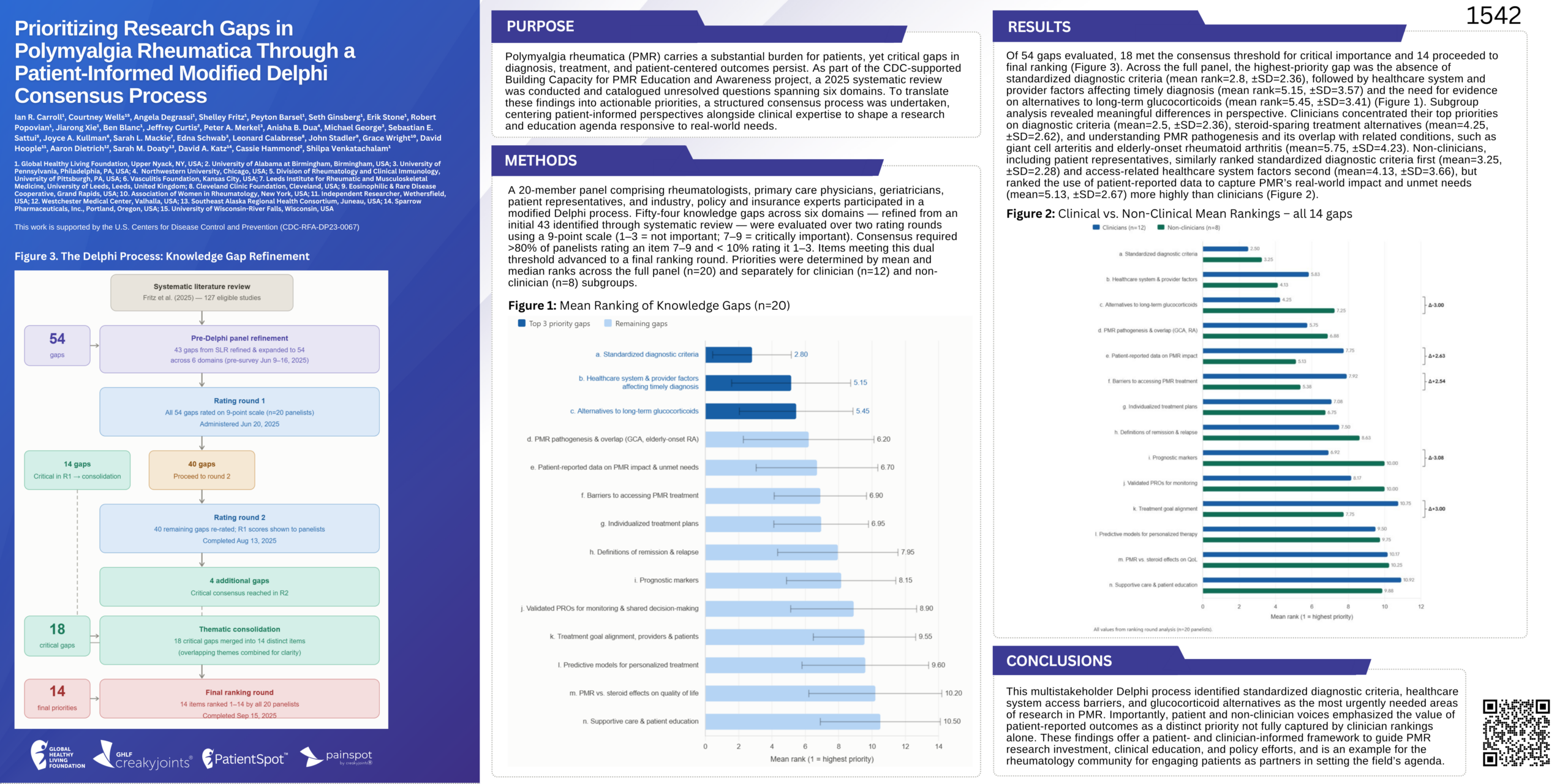
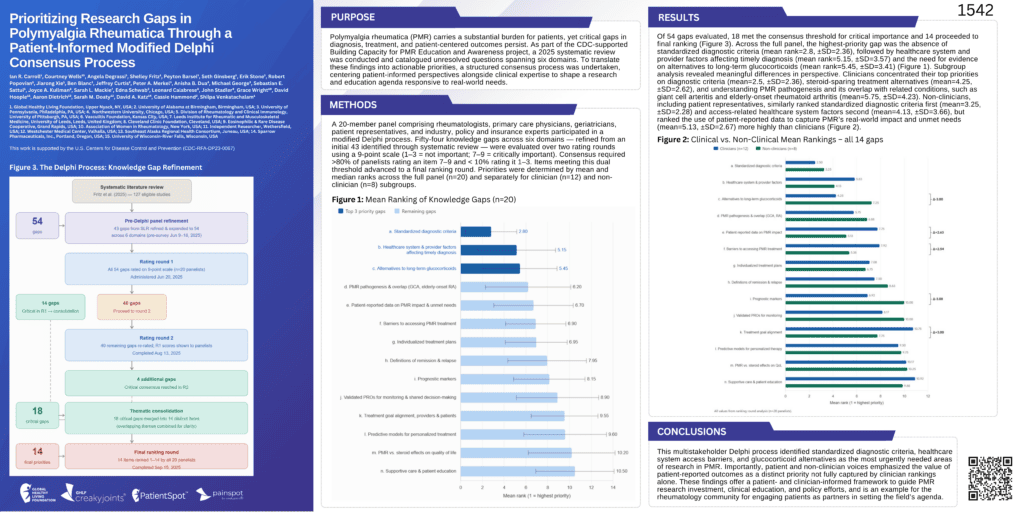
The second study, “Prioritizing Research Gaps in Polymyalgia Rheumatica Through a Patient-Informed Modified Delphi Consensus Process,” asked a simple question: What are the most important unanswered questions in PMR research?
To find out, GHLF brought together a 20-member panel of rheumatologists, primary care doctors, geriatricians (doctors who care for older adults), patient representatives, and experts in industry, policy, and insurance. The panel used a method called a modified Delphi process, where experts rate ideas over several rounds until they reach agreement.
The panel started with 54 research gaps found in a 2025 review of published PMR studies. Over two rounds of rating, 18 gaps were rated critically important by nearly the whole panel. These were combined into 14 final topics, which the panel then ranked.
The top 3 research priorities
- Clear, standard criteria for diagnosing PMR
- Health system and health care provider factors that delay diagnosis
- Evidence on alternatives to long-term steroids
How patients’ views shaped the results
The researchers also compared rankings from 12 clinicians with rankings from 8 non-clinicians, including patient representatives. Both groups ranked clear diagnostic criteria first.
Non-clinicians ranked barriers to timely diagnosis and care second. They also gave more weight than clinicians did to using patient-reported data to understand how PMR affects daily life. This shows that including patients brings up priorities that clinicians alone might miss.
Why do these findings matter for people with PMR?
Together, these studies show that the questions people with PMR care about most — how to taper steroids safely, what other treatments exist, and how to get a clear diagnosis — are also the areas where education and research need the most work.
“Being selected for a podium presentation at ACR Convergence is a testament to the rigor of this work and, more importantly, to why it matters,” said Seth Ginsberg, President and Co-Founder of GHLF. “PMR has historically been underserved by patient-centered research. Our CDC-funded study shows that the gaps in education are real, measurable, and addressable — and patients deserve better.”
You can use these findings at your next appointment:
- Ask about your tapering plan. If you take steroids, ask how and when your dose will be lowered and what to do if symptoms come back.
- Ask about other options. If you’re concerned about long-term steroid use, ask whether other treatments might be right for you.
- Ask questions about your diagnosis. If you’re unsure why you were diagnosed with PMR or what it means for you, ask your health care provider to explain.
- Share how PMR affects your life. Tell your health care provider about pain, stiffness, fatigue, and how they affect your daily activities.
Where can I see this research, and how can I get involved?
The podium presentation*, “Convergent and Divergent Gaps in PMR Education: Findings from a CDC-Funded Multi-Method Needs Assessment,” will be presented by Angela Degrassi of GHLF during the session Patient Education/Community Programs: Patient Knowledge and Awareness on Wednesday, November 11, 2026, from 12:00 to 12:15 PM ET. You can read the abstract on the ACR website.
The poster**, “Prioritizing Research Gaps in Polymyalgia Rheumatica Through a Patient-Informed Modified Delphi Consensus Process,” will be presented by Ian Carroll of GHLF during Poster Session B — Patient Outcomes, Preferences, & Attitudes on Monday, November 9, 2026, from 10:30 AM to 12:30 PM ET (poster 1542).
Studies like these happen because patients share their experiences. To take part in future research, join PatientSpot, GHLF’s patient research registry.
Frequently asked questions
How many people in the U.S. have polymyalgia rheumatica?
Polymyalgia rheumatica (PMR) affects an estimated 700,000 Americans, most often adults over age 50.
What do people with PMR most want to know?
In a 2026 GHLF study of questions submitted by 144 webinar registrants, the most common topic was how to taper steroids and manage steroid doses, followed by remission and what to expect over time.
How much do health professionals know about PMR?
In the same study, 417 health professionals scored an average of 65% on a PMR knowledge assessment, and only 12% scored 80% or higher.
What are the most important research priorities for PMR?
A GHLF panel of patients and experts ranked clear diagnostic criteria, health system factors that delay diagnosis, and alternatives to long-term steroids as the top three research priorities.
Learn more at Live PMR
*The podium study team includes Angela Degrassi, Ian Carroll, Peyton Barsel, Jiarong Xie, Mary Dunn, Amelia Prouse, Erik Stone, Shelley Fritz, and Shilpa Venkatachalam of GHLF.
**The poster study team includes Ian R. Carroll, Angela Degrassi, Shelley Fritz, Peyton Barsel, Seth Ginsberg, Erik Stone, Robert Popovian, Jiarong Xie, Ben Blanc, and Shilpa Venkatachalam of GHLF, along with Courtney Wells, Jeffrey Curtis, Peter A. Merkel, Anisha B. Dua, Michael George, Sebastian E. Sattui, Joyce A. Kullman, Sarah L. Mackie, Edna Schwab, Leonard Calabrese, John Stadler, Grace Wright, David Hoople, Aaron Dietrich, Sarah M. Doaty, David A. Katz, and Cassie Hammond.
Carroll IR, Wells C, Degrassi A, et al. Prioritizing research gaps in polymyalgia rheumatica through a patient-informed modified Delphi consensus process. Poster presented at: ACR Convergence 2026; November 6-11, 2026; Orlando, FL. Abstract 1542.
Degrassi A, Carroll I, Barsel P, et al. Convergent and divergent gaps in PMR education: findings from a CDC-funded multi-method needs assessment [abstract]. Arthritis Rheumatol. 2026;78(suppl 9). Accessed November 3, 2026. https://acrabstracts.org/abstract/convergent-and-divergent-gaps-in-pmr-education-findings-from-a-cdc-funded-multi-method-needs-assessment/