
CreakyJoints · Global Healthy Living Foundation
The Current Reality:
You have suffered from osteoarthritis for far too long.
This wait could be over with a breakthrough treatment (lorecivivint or “LOR”)
We need your support to make LOR available for you.
LOR in Numbers:
~2,000: Patients studied across 11 trials in the US.
3: Improved joint structure, pain, and function (three hallmarks of OA).
0: Serious adverse events related to treatment.
Urgent Call to Action:
ACT NOW.
LOR has been submitted to the FDA for review.
Scroll down for further information and detail.
* LOR has not yet been approved by the FDA.
The Scale of the Problem
Knee OA by the numbers
30
Years since a new treatment approach for knee OA
25 Million
Americans living with knee osteoarthritis
650,000
Knee replacements performed each year in the US
$136 Billion
Annual economic cost of osteoarthritis in the US
Sources: IFHMaE (knee OA prevalence); OARSI; CDC; AAOS. Economic cost estimated from Cisternas et al., Arthritis Care & Research, 2016.
A New Approach
An Investigational Therapy with the Potential to Address Pain and Disease Progression Is Before the FDA
LOR is an investigational small-molecule therapy developed for knee osteoarthritis, which is being developed by San-Diego-based Biosplice Therapeutics, Inc. According to Biosplice-provided materials, LOR was designed to engage two biological pathways inside the knee joint, one associated with inflammation and one associated with cartilage breakdown. Biosplice reports that LOR has been evaluated in multiple clinical trials, including randomized, placebo-controlled studies, to assess its effects on pain, physical function, and joint structure. The lack of meaningful therapeutic innovation in osteoarthritis has left many patients relying on symptom management, injections, physical therapy, and, ultimately, joint replacement surgery. Patients deserve the opportunity to make their experiences heard as FDA evaluates potential new options.
Contact your representatives and ask them to recognize the urgent unmet need in osteoarthritis and support a full, fair, and science-based FDA review of lorecivivint.
Patient Stories
Hear from an Osteoarthritis Expert
Dr. Vinod Dasa discusses the limitations of current osteoarthritis treatment options, the need for continued innovation, and why patients should share their experiences with policymakers.
How It Works
What Is Lorecivivint?
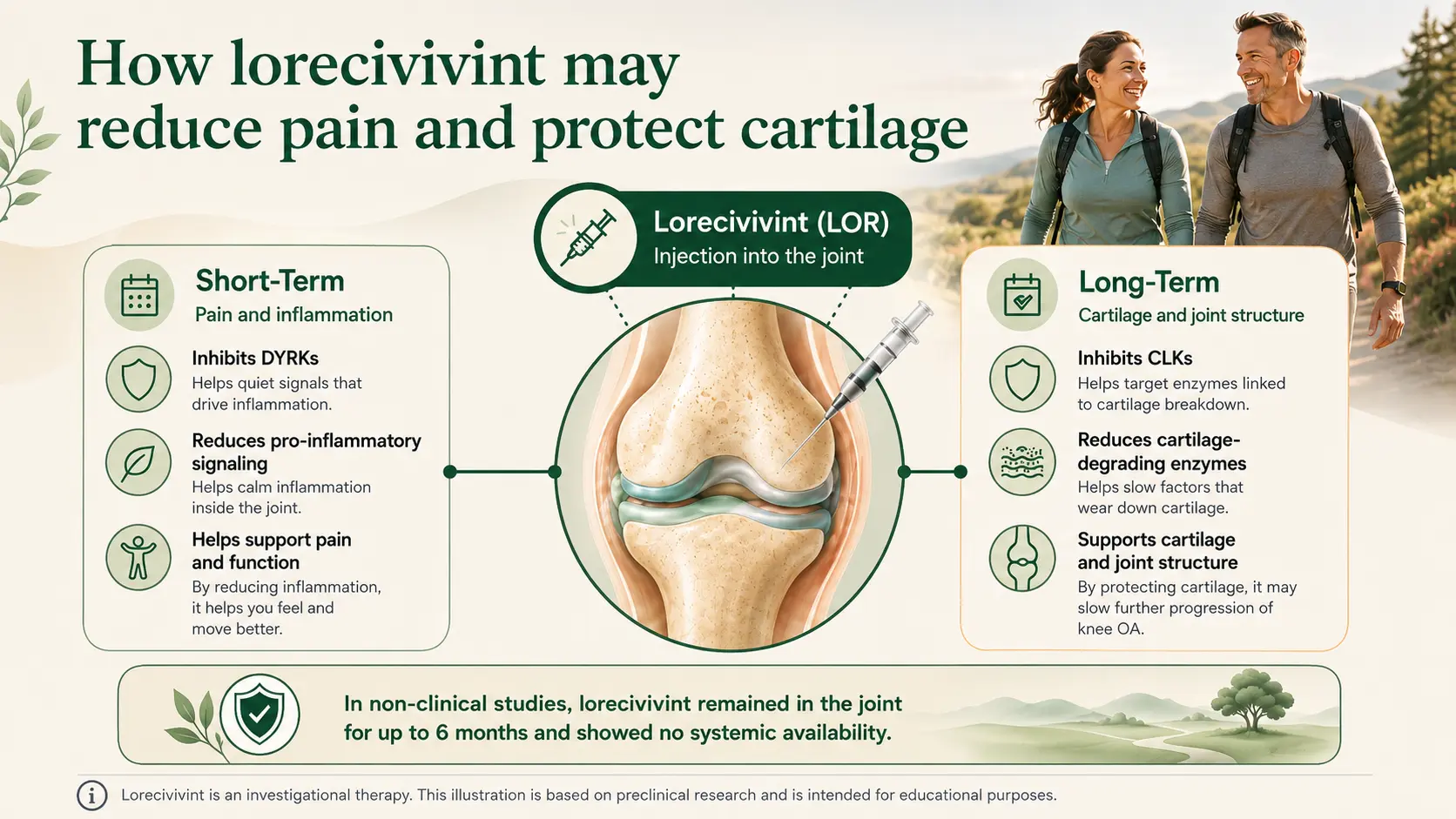
Lorecivivint is an investigational small-molecule therapy administered by injection into the knee joint. It has not been approved by the FDA for any use.
Clinical Evidence
What the trials showed
Reduction in WOMAC Pain scores at 6 months — compared to 5% for the placebo group. By 12 months, placebo patients’ pain had worsened while patients in the LOR group continued to improve.
Phase 3 OA-07, WOMAC Pain subscale, Week 24 (p=0.044) and Week 48 (p=0.029). Presented at ACR Annual Meeting, November 2024.
Improvement in ability to perform daily activities — walking, climbing stairs, getting in and out of chairs — measured on the validated WOMAC Function scale. At 12 months, the placebo group had declined while LOR patients held their gains.
Phase 3 OA-07, WOMAC Function subscale, Week 24 and Week 48 (p=0.035). Confirmed in pooled analysis of 843 patients (p=0.045 at 12 months).
Medial joint space width (mJSW) is a measure of cartilage thickness in the knee joint, assessed by radiograph. After two years of treatment with two yearly LOR injections, patients gained a small amount of cartilage thickness from their baseline — while the placebo group showed continued loss.* The treatment difference at Year 2 was approximately 0.38 mm. The medical community generally considers a difference greater than 0.13 mm to be meaningful on X-ray — placing this result well above that threshold.
Phase 3 OA-07, change from baseline in medial JSW at Week 100. LOR-LOR cohort vs. extrapolated placebo (p<0.001). * Placebo patients crossed over to active treatment at Week 48; the Year 2 placebo value was extrapolated based on the rate of cartilage loss observed during the first year of the study.
Across clinical studies, side effects in the injected knee — such as temporary joint discomfort — occurred at nearly identical rates in LOR and placebo patients, consistent with the injection procedure itself. Overall adverse event rates were comparable between the two groups. And because no systemic drug exposure has been detected in any patient, the broader-body risks of oral or systemic therapies do not apply.
Integrated Safety Summary, 9 pooled clinical studies, 1,744 LOR-treated patients (1,149 at the 0.07 mg dose). Target-knee-related and overall adverse event rates were similar between LOR and placebo groups.
Conference Presentations & Peer-Reviewed Articles
Read the source publications
Presentation
OA-07 – Phase 3 Trial – Time to Worsening in Pain and Function Over 2 Years
ACR Convergence 2025
Presentation
OA-06 – Phase 2 Trial – Safety of 4 Injections Across 24 Months
ACR Convergence 2022
Journal
OA-02 – Phase 2A Proof of Concept Trial – 52-week Efficacy & Safety Following Single Injection
Arthritis & Rheumatology, 2020
Abstract
OA-07 – Phase 3 Trial – Efficacy and Safety Following Two Annual Injections
ACR Convergence 2024
Journal
OA-04 – Phase 2B Dose Finding Trial – 24-week Efficacy & Safety Following Single Injection
Osteoarthritis & Cartilage, 2021
Biosplice has studied lorecivivint in clinical trials involving people with knee osteoarthritis. Select a card to learn more about the reported study outcomes. Lorecivivint remains investigational and has not been approved by the FDA.
Why Your Voice Matters
Share Your Experience
Tell Congress how osteoarthritis affects your pain, mobility, independence, work, and family life.
Explain the Unmet Need
Help policymakers understand why current treatment options do not meet the needs of many patients.
Support Innovation
Encourage continued research and a fair scientific process for evaluating potential new therapies, including LOR.
Make Your Voice Heard
Show policymakers why people living with osteoarthritis need better options and greater attention.
Write Congress About Osteoarthritis Innovation
Personalize a short letter explaining how osteoarthritis affects your life and why patients need better treatment options.
Your letter may identify LOR as one investigational therapy and ask Congress to recognize the unmet need in osteoarthritis and support a fair, complete, science-based review. Your letter should not ask Congress to direct FDA to approve any particular product.
Common Questions
Frequently asked questions
LOR is an investigational therapy for knee osteoarthritis and provides the immediate context for this advocacy effort. Its development reflects the broader need for continued innovation and better treatment options for patients.
No. The FDA determines whether a drug meets the standards for approval. The campaign asks Congress to recognize the unmet need in osteoarthritis and support a fair, complete, science-based review of potential new therapies.
This campaign receives support from Biosplice Therapeutics, the developer of LOR. GHLF and CreakyJoints developed and host the patient advocacy materials on this webpage. GHLF does not endorse any particular product.
Your address enables GHLF (CreakyJoints) to identify your U.S. Representative and Senators and route your letter to the appropriate congressional offices.
This campaign receives support from Biosplice Therapeutics, the developer of lorecivivint, or LOR. LOR is an investigational therapy and has not received FDA approval. GHLF and CreakyJoints do not endorse any particular product or FDA outcome. This material provides general information and does not constitute medical advice.