
Key Takeaways
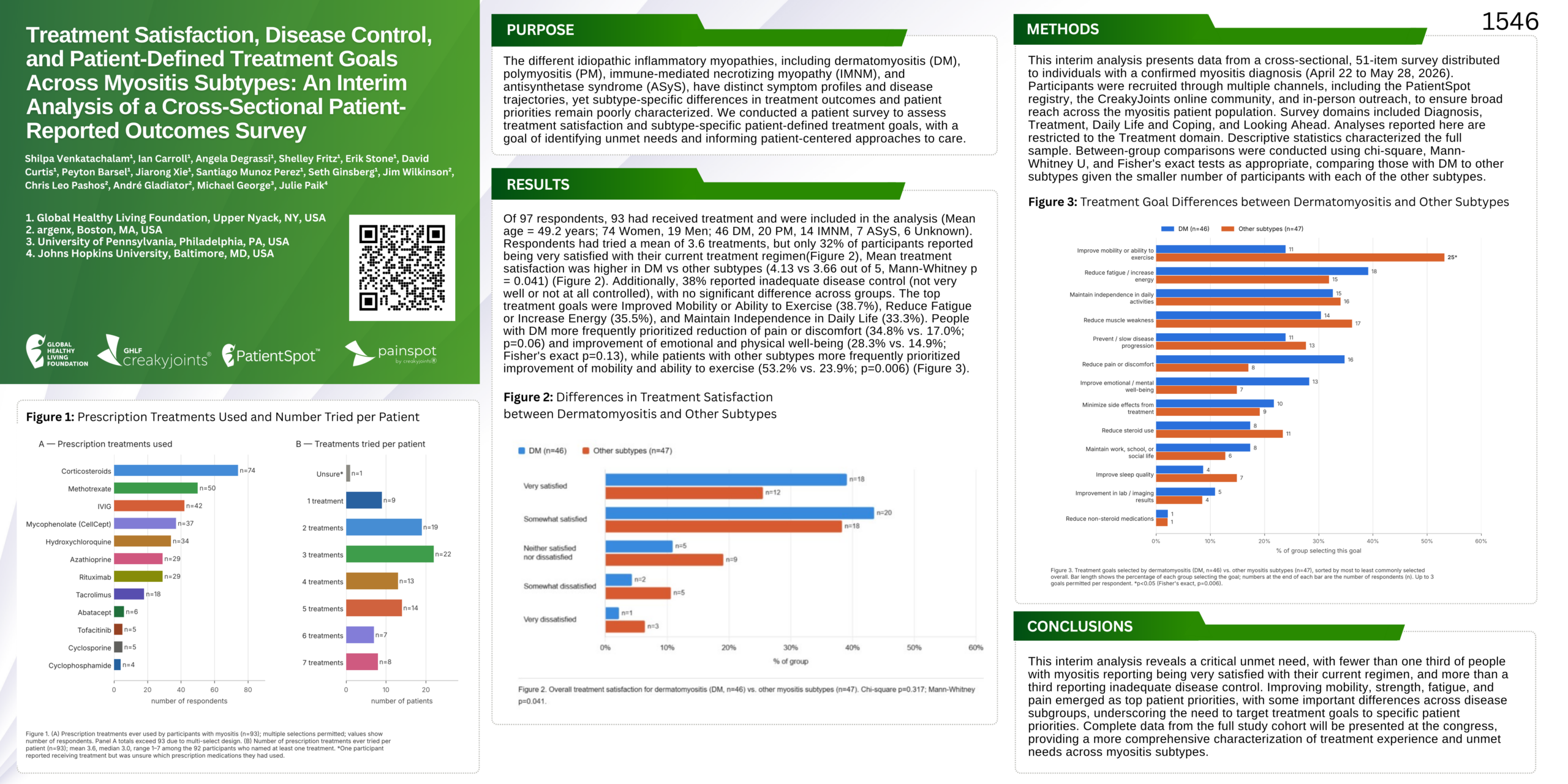
- Many people with myositis are not fully satisfied with treatment. Only 32% said they were very satisfied, even after trying an average of 3 to 4 treatments.
- More than 1 in 3 feel their disease is not under control. About 38% said their myositis was not very well controlled or not controlled at all.
- Patients want to move, have energy, and stay independent. These were the top treatment goals, and priorities differed by myositis type.
A 2026 survey of 93 people with myositis by the Global Healthy Living Foundation (GHLF) found that fewer than 1 in 3 are very satisfied with their current treatment. The findings will be shared at ACR Convergence 2026, the American College of Rheumatology’s annual meeting, held November 6–11 in Orlando, Florida.
GHLF and its patient research registry, PatientSpot, are presenting six research studies at this year’s meeting. This article covers one of them: a survey that asked people living with myositis what their treatment is like, how well their disease is controlled, and what they most want treatment to do for them.
Myositis is rare, and patients’ own views are often missing from research. This study puts those views front and center. It also shows a gap between what patients live with every day and what doctors usually measure — a gap that matters when you and your care team make treatment decisions together.
What is myositis?
Myositis is a group of rare diseases in which the immune system attacks the muscles, causing inflammation. This can lead to muscle weakness, tiredness, and trouble with everyday tasks like climbing stairs or getting up from a chair. Some types also affect the skin, lungs, or joints.
There are several types, and each can look and feel different. The survey included people with:
- Dermatomyositis (DM): muscle weakness along with a skin rash
- Polymyositis (PM): muscle weakness without the skin rash
- Immune-mediated necrotizing myopathy (IMNM): a type that can cause sudden, severe muscle damage
- Antisynthetase syndrome (ASyS): muscle inflammation that often affects the lungs and joints too
Because myositis is rare and comes in many forms, it is not well understood outside of large academic medical centers. Very little research has looked at how people with different types feel about their treatment.
What was the survey about?
The online survey ran from April 22 to May 28, 2026, and was open to adults with a confirmed myositis diagnosis. People were invited through the PatientSpot registry, the CreakyJoints online community, and in-person outreach.
The survey had 51 questions covering diagnosis, treatment, daily life and coping, and looking ahead. These early results focus on treatment.
Of 97 people who responded, 93 had received treatment and were included. Here is who took part:
- Average age: about 49
- Gender: 74 women and 19 men
- Myositis type: 46 with dermatomyositis, 20 with polymyositis, 14 with IMNM, 7 with antisynthetase syndrome, and 6 who were unsure of their type
Because about half the group had dermatomyositis, researchers compared people with dermatomyositis to everyone with other types combined.
What did people with myositis say about their treatment?
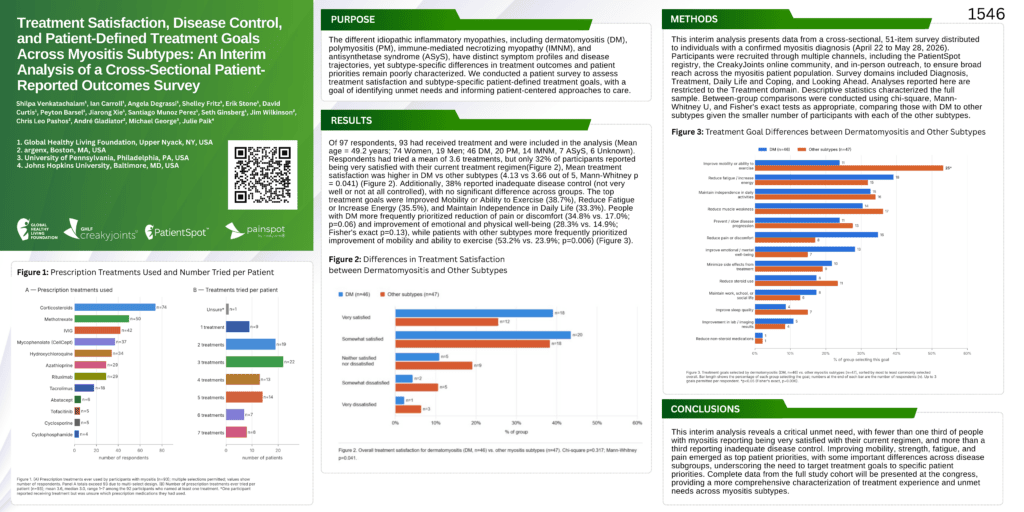
Many people are still searching for the right treatment. Participants had tried an average of 3 to 4 prescription treatments. Corticosteroids (like prednisone) were the most common, followed by methotrexate and IVIG (intravenous immunoglobulin).
Most are not fully satisfied. Only 32% said they were very satisfied with their current treatment. People with dermatomyositis were somewhat more satisfied than people with other types, rating their treatment about 4.1 out of 5 compared with about 3.7.
Many feel their disease is not under control. About 38% — more than 1 in 3 — said their myositis was not very well controlled or not controlled at all. This was true across all myositis types.
Patients want to move, have energy, and stay independent. When asked to pick their top treatment goals, people most often chose:
- Being able to move more easily or exercise (39%)
- Less fatigue and more energy (36%)
- Staying independent in daily life (33%)
Goals differ by myositis type. People with other types of myositis were more than twice as likely as people with dermatomyositis to name better movement and exercise as a top goal (53% vs. 24%). People with dermatomyositis more often wanted less pain or discomfort (35% vs. 17%) and better emotional and physical well-being (28% vs. 15%), though these differences were smaller and could be due to chance.
These are early results. Findings from the full group of participants will be shared at the meeting.
Why might this matter to you?
The results show that how patients define “good treatment” does not always match what clinical trials measure. For many people, success means walking farther, having enough energy for the day, and doing things on their own — not just better lab results.
“Patients living with myositis are navigating one of the most complex and underrecognized areas of rheumatology,” said Shilpa Venkatachalam, PhD, Chief Patient Centered Research and Ethical Oversight Officer at GHLF. “This research helps us understand what matters most to patients, not what we assume matters, and that distinction is foundational to improving care. At GHLF, patient-centered research isn’t a methodology; it’s a commitment. Every study we bring to ACR Convergence starts with a simple question: what do patients need science to answer? That’s what drives this work, and that’s what makes it matter.”
You can use these findings at your next appointment:
- Name your own goals. Tell your doctor what you most want treatment to help with, whether that’s moving more, having more energy, or easing pain.
- Be honest about how you’re doing. If your treatment isn’t working well enough, say so. You are not alone — more than 1 in 3 people in this survey felt the same.
- Ask how your type affects your plan. Different types of myositis can call for different goals and approaches.
Where can I see this research, and how can I get involved?
The poster, “Treatment Satisfaction, Disease Control, and Patient-Defined Treatment Goals Across Myositis Subtypes: An Interim Analysis of a Cross-Sectional Patient-Reported Outcomes Survey,” will be presented during Poster Session B — Patient Outcomes, Preferences, & Attitudes on Monday, November 9, 2026, from 10:30 AM to 12:30 PM ET.
The research team includes Shilpa Venkatachalam, Ian Carroll, Angela Degrassi, Shelley Fritz, Erik Stone, David Curtis, Peyton Barsel, Jiarong Xie, Santiago Munoz Perez, and Seth Ginsberg of GHLF; Jim Wilkinson, Chris Leo Pashos, and André Gladiator of argenx; Michael George of the University of Pennsylvania; and Julie Paik of Johns Hopkins University.
Studies like this one happen because patients share their experiences. To take part in future research, join PatientSpot, GHLF’s patient research registry.
Frequently asked questions
How many people with myositis are satisfied with their treatment? In the 2026 GHLF survey of 93 people with myositis, only 32% said they were very satisfied with their current treatment.
How many people with myositis feel their disease is under control? About 38% of survey participants said their myositis was not very well controlled or not controlled at all.
What do people with myositis want most from treatment? The top goals were being able to move more easily or exercise (39%), having less fatigue and more energy (36%), and staying independent in daily life (33%).
Do treatment goals differ by type of myositis? Yes. People with polymyositis, IMNM, or antisynthetase syndrome were more than twice as likely as people with dermatomyositis to name better movement and exercise as a top goal (53% vs. 24%).
Want help reaching your own treatment goals?
People in this survey said they most want to move more easily, have more energy, and stay independent. Two free CreakyJoints guides, written for people living with myositis, can help you work toward those goals and talk about them with your doctor.
- Myositis Wellness Guide: Practical, caring tips to help you move safely, eat well, manage flares, and take care of yourself from the inside out.
- Myositis Conversation Starter Guide: Organize your thoughts before your appointment and use simple prompts to guide the conversation, so you feel more confident and make the most of your time with your doctor.
Download your free myositis guides
Venkatachalam S, Carroll I, Degrassi A, et al. Treatment satisfaction, disease control, and patient-defined treatment goals across myositis subtypes: an interim analysis of a cross-sectional patient-reported outcomes survey. Poster presented at: ACR Convergence 2026; November 6-11, 2026; Orlando, FL. Abstract 1546. https://ghlf.org/wp-content/uploads/2026/10/ACR-2026-3-1.pdf