
If you have ever heard the name of a medication ending in “-mab,” you have encountered a monoclonal antibody. While the name may sound complicated, the basic idea behind monoclonal antibodies is actually quite simple: they are medicines designed to work in a similar way to the antibodies your body naturally makes to help protect you from illness.
For many people, terms like “monoclonal antibody” can feel confusing or intimidating, and this is completely understandable! These medications have become more common in recent years, and understanding what they are, and what they are not, can help patients feel more informed and comfortable when discussing treatment options with their healthcare providers.
What Are Antibodies?
To understand monoclonal antibodies, it helps to start with antibodies themselves. Antibodies are proteins made by your immune system. Their job is to recognize things that do not belong in your body, such as viruses, bacteria, and other harmful substances. Think of antibodies as highly trained security guards, with each antibody designed to recognize one specific target. When your immune system encounters a virus or bacteria, it creates antibodies that can attach to that threat. Once attached, the antibodies can help prevent the invader from causing harm or signal other parts of the immune system to destroy it. This process happens naturally every day as your body protects itself from infection.
What Makes a Monoclonal Antibody Different?
A monoclonal antibody is a laboratory-made antibody designed to mimic the work of the body’s natural antibodies. Scientists create these medications in a laboratory to recognize and attach to one specific target. Depending on the medication, that target might be a virus, a protein involved in inflammation, or another substance linked to disease.
The term “monoclonal” simply means that all of the antibody molecules are copies of a single original antibody. Since they are identical, they can consistently recognize the same target. In other words, monoclonal antibodies are carefully engineered versions of the body’s natural defense tools.
How Do Monoclonal Antibodies Work?
Different monoclonal antibodies work in different ways, but most follow the same basic principle– they attach to one specific target and help the body respond.
Some monoclonal antibodies can:
- Block a virus or bacteria from entering cells
- Help the immune system recognize and remove harmful substances
- Reduce excessive inflammation
- Prevent certain disease processes from progressing
Because they are designed to target one specific molecule, monoclonal antibodies can often act more precisely than medications that affect many systems throughout the body.
How Are They Used?
Monoclonal antibodies are used in many areas of medicine. Some monoclonal antibodies help prevent or treat certain infections. Others are used to manage autoimmune diseases, inflammatory conditions, allergies, or even certain types of cancer. Examples include treatments for conditions such as severe asthma, migraine prevention, osteoporosis, inflammatory bowel disease, rheumatoid arthritis, and various cancers. Researchers continue to develop new monoclonal antibodies for a growing number of medical conditions each day and transform modern medicine.
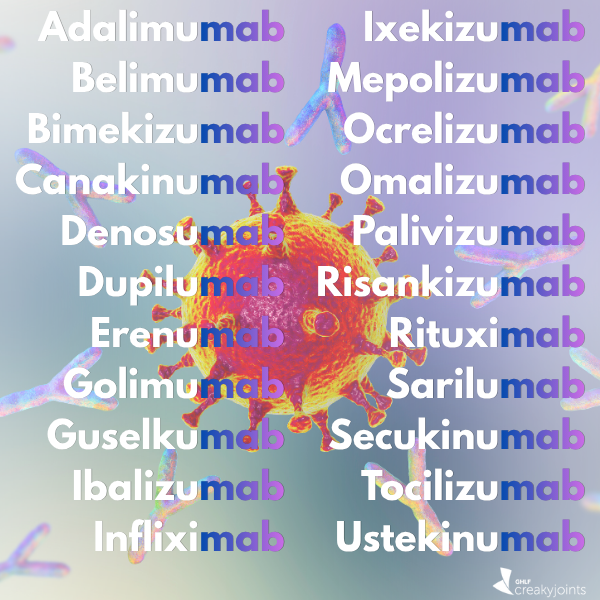
A Simple Tip: Look for “-mab”
One easy way to recognize a monoclonal antibody medication is by its name. By international naming standards, monoclonal antibody medications end in the suffix “-mab.”
Examples include:
- Omalizumab
- Adalimumab
- Pembrolizumab
- Nivolumab
- Dupilumab
While the medications themselves work differently depending on their target, the “-mab” ending tells healthcare professionals that the medicine is a monoclonal antibody.
How Are Monoclonal Antibodies Given?
Monoclonal antibodies are usually not taken as pills, because they are proteins that would be broken down by the digestive system before they could work properly. Instead, they are typically given by injection or by intravenous (IV) infusion. An intravenous (IV) infusion means the medication is delivered directly into a vein over a period of time, often in a clinic, infusion center, or hospital setting. The length of the infusion depends on the specific medication. Some monoclonal antibodies can also be self-administered at home using prefilled syringes or injection devices. This all depends on the treatment plan and healthcare provider’s recommendations.
Are Monoclonal Antibodies Safe?
Like all medications, monoclonal antibodies can have side effects and potential risks. The most common side effects vary depending on the medication but may include:
- Injection-site reactions
- Headache
- Fatigue
- Mild flu-like symptoms
Some people may experience infusion-related reactions during or shortly after treatment. In very rare cases, a severe allergic reaction called anaphylaxis can occur. Healthcare teams monitor patients closely when infusions are given to help manage any reactions if they occur. Before starting a monoclonal antibody, your healthcare provider will discuss the potential benefits and risks based on your individual medical situation.
One Tool Among Many
It is important to understand that monoclonal antibodies are not a replacement for every other treatment or preventive strategy. Monoclonal antibodies are one tool in a toolbelt of many that healthcare professionals may use to help prevent or treat disease.
Depending on the condition, monoclonal antibodies may be used alongside other medications, lifestyle measures, vaccines, and/or medical treatments. There is often even great variation from person to person.
The Bottom Line
Monoclonal antibodies are laboratory-made proteins designed to act like the body’s natural antibodies. They target specific substances involved in disease and can help prevent or treat a variety of conditions, including certain infections and immune-related diseases.
If you see a medication name ending in “-mab,” you can be confident that it is a monoclonal antibody. Some are given as injections, while others are administered through IV infusions.
Although the science behind these medications is complex, the goal is straightforward: to provide highly targeted treatment that supports the body’s ability to stay healthy. If monoclonal antibodies have been recommended to you or a loved one, asking questions and learning more is an important step toward making informed healthcare decisions.
American Academy of Allergy, Asthma & Immunology. (2024). Biologics for the treatment of asthma, allergy, and immunologic diseases. https://www.aaaai.org
American Cancer Society. (2025). Monoclonal antibodies and their side effects. https://www.cancer.org/cancer/managing-cancer/treatment-types/immunotherapy/monoclonal-antibodies.html
Malik, B., & Ghatol, A. (2023). Monoclonal antibodies in clinical practice. In StatPearls. StatPearls Publishing. https://www.ncbi.nlm.nih.gov/books/NBK572118/
National Cancer Institute. (2024). Monoclonal antibodies. https://www.cancer.gov/about-cancer/treatment/types/immunotherapy/monoclonal-antibodies
U.S. Food and Drug Administration. (2024). Monoclonal antibodies. https://www.fda.gov
World Health Organization. (2023). International nonproprietary names (INN) for biological and biotechnological substances. https://www.who.int
Weiner, G. J. (2015). Building better monoclonal antibody-based therapeutics. Nature Reviews Cancer, 15(6), 361–370. doi.org/10.1038/nrc3930