

Living with myositis means navigating a condition that can look and feel different from person to person—and even from day to day. Muscle weakness, fatigue, skin changes, and other symptoms can shift in ways that can be hard to keep track of on your own.
That is why tracking your symptoms can be one of the most powerful things you do for your health. Writing down your experiences as they happen can really help you provide clear information during each doctor’s visit.
Here are practical ways to track your myositis symptoms and use that information to get better care.
Myositis Symptoms
Myositis is a group of rare inflammatory muscle diseases. The most common types include dermatomyositis, polymyositis, immune-mediated necrotizing myopathy (IMNM), and inclusion body myositis (IBM). Each type can cause a different set of symptoms, and the same myositis type can affect two people very differently.
Common symptoms across myositis types may include:
- Muscle weakness, especially in the hips, thighs, shoulders, and upper arms
- Fatigue that does not go away with rest
- Difficulty climbing stairs, rising from a chair, or lifting your arms
- Muscle pain or tenderness
- Trouble swallowing (dysphagia)
- Shortness of breath or lung involvement
- Skin rashes (more common in dermatomyositis), including redness around the eyes, knuckles, or elbows
- Joint pain or stiffness
- Unintended weight loss
- Raynaud’s phenomenon (fingers turning white or blue in the cold)
6 Reasons to Track Your Myositis Symptoms
1. It helps you communicate quickly with your doctor. That appointment you’ve been waiting for usually ends up being too short to thoroughly convey what you’ve been going through the last several months. Because myositis symptoms can come and go, worsen gradually, or overlap with other conditions, it can be hard to give your doctor an accurate picture during a short appointment.
2. It’s easy to forget how you feel when it is changing from day to day and week to week. You might walk into the appointment feeling relatively okay that day, even if the past three weeks were rough. Or you might struggle to remember exactly when your fatigue got worse or whether your weakness has been building slowly or came on suddenly. Tracking your symptoms helps fill that gap, and it does more than just jog your memory.
3. It gives your doctor something concrete to work with. Instead of saying, “I’ve been feeling kind of off lately,” try being more specific. Example: “My leg weakness has been getting worse over the past four weeks, especially on the stairs.” Specific and dated information helps your doctor figure out whether your symptoms are stable, trending in the wrong direction, or responding to treatment.
4. Tracking symptoms helps to spot patterns. Myositis can flare in response to activity, stress, illness, or medication changes. When you keep tracking symptoms regularly, you’ll start to notice patterns emerging — things you might not have realized on your own. You and your doctor can use that information to help you plan around flares and adjust your activity level or medication.
5. It supports treatment decisions. One challenging aspect of managing myositis is knowing when it’s time to make a change. Your doctor needs to know whether a treatment is working, wearing off, or not working at all. Having real-world data between lab tests and appointments can influence whether your dose stays the same, goes up, or whether a different medication might serve you better.
6. It puts you in the driver’s seat. Coming in with notes and questions means you are not just answering your doctor’s questions — you are helping shape the conversation. That kind of teamwork can lead to better care and help you feel more confident and less alone when dealing with a difficult condition.
What to Track
You do not need to track everything at once. Start with what feels most important or most disruptive to your daily life. You might begin by tracking these symptoms:
Muscle Weakness and Function
- How easy or hard it is to do everyday tasks (climbing stairs, getting up from a chair, washing your hair, carrying groceries)
- Which muscle groups feel weaker — hips, shoulders, hands, neck
- Whether weakness is getting better, worse, or staying the same
Fatigue
- Your energy level each day, on a simple scale (such as 1 to 10)
- Whether fatigue limits your activities
- How well you slept the night before
Pain and Discomfort
- Where you feel pain or tenderness in your body
- How the pain interferes with activities (work, household, social)
- How intense the pain is (a 0 to 10 scale may help you rate pain)
- How long the pain lasts and if anything triggers the pain
- What makes pain better or worse
Skin Changes (especially for dermatomyositis)
- New or changing rashes, redness, or scaling
- Location of skin changes (eyelids, knuckles, elbows, chest, back)
- Whether skin symptoms flare when other symptoms flare
Swallowing and Breathing
- Any difficulty swallowing food, liquids, or pills
- Coughing or choking during meals
- Shortness of breath during light activity or at rest
- Any changes in your voice
How to Track Your Myositis Symptoms
There is no single right way to track your symptoms. The best method is the one you will use consistently.
Here are several options:
Use a Digital Symptom Tracker (An App)
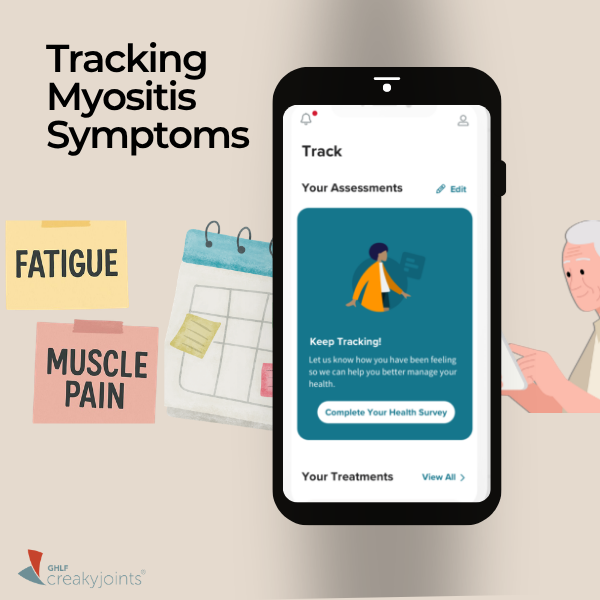
One of the easiest ways to track your myositis symptoms is through a free digital platform called PatientSpot. Having a record that spans weeks and months is especially useful when your doctor asks, “Have things changed since your last visit?” Instead of trying to remember, you can show them.
PatientSpot is designed by and for people living with chronic conditions, not specifically people with myositis.
Through the platform, you can:
- Log symptoms, pain levels, fatigue, and daily function over time
- Track how your condition changes from week to week or month to month
- Record when you start or end medications and any side effects
- Use the journal to note symptom details
- Generate reports that you can share with your doctor or care team
- Connect with customized resources such as articles, videos, and podcasts
You can sign up for free at PatientSpot.org.
Write It Down in the Moment
Symptoms can be easy to forget, especially if they happen between appointments. Keeping a simple notepad, journal, or planner nearby — or using the notes app on your phone — lets you capture what is happening when it happens.
Try jotting down:
- The date and time
- Which symptoms you noticed and where they impact your body
- How intense the symptoms were and how long they lasted
- What you were doing before or when it started
- Anything that seemed to help or make it worse
Examples
- Tuesday,4/28: really tired after grocery shopping, my legs felt heavy. I felt better after doing my physical therapy exercises.
- Thursday, 4/30: needed help getting out of bed and getting dressed, arm muscles too weak to lift shirt over head to get dressed
Use a Calendar to Spot Patterns
A monthly paper calendar or a digital calendar (like the one on your phone) can work well for tracking symptom patterns over time. Use a simple system that works for you:
- Color-code your days by how you felt (For example, green = good, yellow = okay, red = hard day)
- Note when you had new or worsening symptoms
- List when you started or stopped a medication
- Note when you saw your doctor or had a lab test
A calendar view helps you and your doctor see trends — like whether you feel worse after certain activities, at certain times of the month, or after a medication change.
Write Down Your Questions and Bring Them to Your Appointment
One of the most important parts of tracking is not just noting your symptoms — it is using that information to ask better questions. When you think of a question about your care, write it down right away. Do not wait until your appointment to try to remember it.
Keep a running list of questions in your notepad, notes app, or symptom tracker. Common questions people with chronic conditions like myositis ask include:
- “My legs have felt weaker over the past two weeks — could this be a flare?”
- “I noticed new skin changes on my elbows. Should I be concerned?”
- “I have been having more trouble swallowing. Is this related to my myositis?”
- “My fatigue has been much worse. Is there anything we can do?”
- “Should I change my activity level if I am having a bad week?”
- “What do my recent lab results show about my myositis?”
Stay in Touch Between Appointments
You do not have to wait until your next scheduled visit if something changes or a question comes up. Most medical practices have a patient portal or messaging system that lets you contact your care team between appointments.
Your symptom notes can help you write a clear, helpful message. For example:
“Hi, I wanted to reach out between appointments. Over the past week, I have had increased weakness in my arms and more trouble lifting things overhead. My fatigue has also been worse than usual. I do not think it is an emergency, but I wanted to flag it. Should I come in sooner, or is there anything I should watch for?”
This kind of message — specific, calm, and based on what you have been tracking — helps your care team give you a faster and more helpful response.
Tips for Making Tracking a Habit
- Start small. Even tracking one or two symptoms consistently is more helpful than trying to track everything and giving up.
- Pick a time of day. Many people find it easiest to log symptoms at the same time each day — like after dinner or before bed.
- Do not worry about being perfect. The overall picture over weeks and months is what matters.
- Keep it accessible. Use whatever is easiest for you — your phone, a notebook on your nightstand, or a digital app like PatientSpot.
- Review your data before appointments. Look back at your notes before each doctor visit so you can summarize what has changed.
Frequently Asked Questions
How often should I track my myositis symptoms?
Weekly tracking gives the most complete picture, but even once or twice per month is helpful. The goal is to capture enough information to notice changes over time, not to create extra stress.
What if my symptoms change a lot from day to day?
That variability is worth tracking! Showing your doctor that you have good days and bad days — and what those look like — is valuable information. It can help guide decisions about treatment and activity.
Is PatientSpot free to use?
Yes. PatientSpot is a free platform for patients living with chronic conditions, including myositis. You can sign up and start tracking at PatientSpot.org.
What if I forget to track something important before my appointment?
Do your best to recall what happened and when. Even an estimate is useful. Over time, consistent tracking will make this less of a concern.
Symptoms Matter
Managing myositis is a partnership between you and your care team. When you track your symptoms — whether through a digital app, a notebook, sticky notes, or a calendar — you bring something important to every conversation with your doctor: the truth of what your daily life actually looks like.
Being prepared with your notes, your questions, and a willingness to share what you have been going through can make a real difference in the care you receive.
Interested in Trying PatientSpot?
Create a free account at PatientSpot.org and begin tracking your myositis symptoms today.
Are you interested in more resources about myositis?
Enter your email below to subscribe and receive our newsletter and resources!
Campanilho-Marques, R., Fonseca, J. E., & Machado, P. M. (2025). Treatment of idiopathic inflammatory myopathies. Joint Bone Spine, 92(6), 105932. doi: https://doi.org/10.1016/j.jbspin.2025.105932
Nagy S, Khan A, Machado PM, Houlden H. Inclusion body myositis: from genetics to clinical trials. J Neurol. 2023 Mar;270(3):1787-1797. doi: https://doi.org/10.1007/s00415-022-11459-3.